
 Since Lee McElroy became director of athletics in 2000, the University of Albany hase won 30 conference championships and made 13 NCAA tournament appearances. How can one forget the men's basketball team's near-upset of the University of Connecticut in 2006, and UAlbany Men's Lacrosse overtime loss in the Elite Eight NCAA Championship game in 2007.
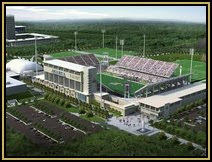
McElroy knows that top athletic programs act as economic development engines, but not without top-notch facilities. This is why he continues pushing a $60 million plan to build a multipurpose athletic stadium.
"Successful people want to be around successful teams and successful programs," McElroy said. This is why it is important for all local business to step up and help the University's cause. There are many ways to support UAlbany and its football program, and one way is to donate to the stadium fund. The local communities of the Gators and the National Champion Tigers both give unbelievable support to their State universities. Now is the time for New York to step up. Let's get support for the University of Albany, New York's State University.
The UAlbany football team has done extremely well in a very short period of time, including its third NEC Championship in 6 years, posting a 8-3 record last Fall, going undefeated in NEC play. Not bad for 9 years in FCS Football.
The victories and success have come despite a football stadium that seats only 5,000 people, one resembling a Division III football field. With the decades and decades of success by Bob Ford’s football program, including Football Championship Series success, it is finally time to upgrade and even reward the University and football team with the proper facilities. After all, the university needs facilities equal to that of its peers.
UAlbany football has risen to the point where they play UMass, Delaware, Montana, New Hampshire, etc.. all among the best in Football Championship Series.
"We already have a tremendous program, but for it to get better we must have better facilities," McElroy said.
He says a new UAlbany stadium would generate millions of dollars in spending for the community and the university each year. That would come not only from football games, but also from possibly being host for opening rounds of the NCAA lacrosse tournament and hosting high school playoff games, in addition to other events.
The money would come not only from increased ticket sales and ticket prices, but also lodging and retail sales.
"We currently have an economic impact, and we don't get cited enough for it," McElroy said. The University of Albany already has a multi –BILLION dollar impact on the capital district (Albany). Without the University, the Albany area would suffer greatly. It's time to reward the University that has given so much to the capital of New York State.
The university is seeking both state and private financing for the stadium. All UAlbany supporters, Alumni, capital district residents and businesses should consider donating to the University.
The athletic department stadium plan needs to be placed as the #1 on the University's priority list in the up and coming budget request. University administrators need to hear this from alumni and supporters alike.
NYS officials need to hear that you support the stadium effort, and why the University and athletic department deserves this stadium and how much positive impact it will have over some many things.
Contact the following government officials and voice your support for the Multi Purpose Stadium. Now is the time to begin letting these officials know that you want state funding included in this year's budget. Call, email, and go in person to the following officials now.
Please contact these officials with the utmost respect and with a high level of intellect... please put significant thought into your presentation before contacting them.
Governor Paterson:
Assemblyman Ron Canestrari:
canestr@assembly.state.ny.us
Assembly Speaker Sheldon Silver:
speaker@assembly.state.ny.us
Assembly Minority Leader James Tedisco:
tediscj@ assembly.state.ny.us
Assemblyman John McEneny
mcenenj@assembly.state.ny.us
NYS Senator Hugh Farley
farley@senate.state.ny.us
NYS Senator Neil Breslin
breslin@senate.state.ny.us
NYS Senate Majority Leader Joe Bruno:
bruno@senate.state.ny.us
NYS Senate Minority Leader Malcom Smith:
masmith@senate.state.ny.us
City of Albany: Mayor Jennings
mayor@ci.albany.ny.us
UAlbany Interim President George M. Philip
presmail@uamail.albany.edu
UAlbany Interim Provost Susan D. Phillips
sdphil@uamail.albany.edu
Heery International Inc. Selected to Study Proposed UAlbany Multi-Purpose Complex
Courtesy: UAlbany Sports Information
Release: 04/04/2008
Courtesy: UAlbany Athletics
Albany, N.Y. -- University at Albany Vice President and Director of Athletics Lee McElroy announced on Friday, April 4 that Heery International Inc. has been selected to study a proposed on-campus multi-purpose stadium complex.
Heery's study, which will take four to six months to complete, will include a site analysis, developing a stadium concept, establishing a project budget and formulating fund-raising materials.
"Heery International's work is the beginning of an exciting project that will benefit the entire Capital Region," McElroy said. "As our Division I athletic program continues to grow, so does the facility needs of our 19 sports. The vision for this athletic complex is something that not only services our athletic programs, but campus, high school and community events. The results of this study will allow us to determine, with respect to funding, what our options will be in the future."
Heery International, an Atlanta-based company founded in 1952, is a full-service design, engineering and construction management firm with 1,100 employees located in 30 offices throughout the United States and Europe.
Heery's list of more than 250 collegiate sports projects and 50-plus collegiate stadiums include a recent renovation and expansion of the Cotton Bowl in Dallas, Texas; eight renovations and expansions of the University of Georgia's Sanford Stadium; and a design for the renovation of the University of Texas' Memorial Stadium.
Tuesday, August 26, 2008
Dr. Lee McElroy and the University of Albany's Quest: The Multipurpose Stadium

Friday, August 22, 2008
UAlbany Athletic Director Lee McElroy Assists With Freshmen Move-In on State Quad
 Courtesy: UAlbany Sports Information
University at Albany Vice President and Director of Athletics Lee McElroy joined the class of 2012 to assist with the freshman class’ move-in onto State Quad resident hall on Friday, Aug. 22.
Approximately 84 freshmen student-athletes will be residing on State Quad during the academic year. Because several of UAlbany’s athletic teams require staying on campus over school breaks, they are placed in dorms that allow recess housing, which includes State Quad. Upperclassmen are able to reside in Freedom and Empire housing.
McElroy, who assists with freshmen move-in each year, is in his ninth year at the helm of the UAlbany athletic department. He believes that getting involved with move-in is a good way to get an early word out about UAlbany athletics. Classes begin on Monday, Aug. 25.
“We are a part of the greater UAlbany community,” McElroy said. “We receive a lot of support from faculty, staff and students, and we want to be able to give back and support the rest of campus as a part of the UAlbany team.”
Wednesday, July 2, 2008
Former Football Star Lee McElroy and His Journey to University of Albany
 When others saw risk, Beaumont native Lee McElroy found opportunity. The oldest of 12siblings, the former Hebert High School football star became the first to go as far from home has he did.
Years later, an unexpected career shift took him from home again, this time on a journey that has allowed him to make as bigger a difference off the field than he ever did on it.
Through it all, McElroy points to a racially segregated upbringing that shaped his values today, as he is one of few African-Americans to run an athletic program at a non-traditionally-black school. "I've had a lot of success everywhere I've been, and that's because I learned to go in and look at an environment and then develop the pieces to make it fit," said McElroy, the director of athletics at New York's University of Albany since 2000.
McElroy, 60, is an older brother to former National Football League players Reggie and Leeland McElroy. Their greatest impacts came on the field, Reggie through 15 years as an offensive lineman and Leeland through three years as a running back.
Although a good enough football player to be a linebacker at UCLA, Lee McElroy's impact came in the classroom. His father the mail carrier and his mother the teacher's aide stressed getting an education. They said his six brothers and five sisters looked to him as an example."Very early on you learned responsibility and accountability," said McElroy, expected to be the first to the dinner table and to make sure the doors were locked for the night.
Branching out
McElroy's responsibilities today include overseeing an expanding athletic department and trying to get financing for an on-campus football stadium. Those tasks, however, were far beyond McElroy's horizon when he left Beaumont for what he called the "culture shock" of UCLA in 1966."Lee wasn't afraid to branch out," said one of McElroy's former Hebert teammates, Bob Pollard, who played 11 seasons in the NFL.
Pollard recalled that he and other Hebert teammates didn't stray beyond Texas Southern University in Houston at a time when McElroy made his cross-country leap.
"There were four or five guys that went to Texas Southern, but he was going all the way to UCLA," said Pollard, who transferred after one season at Texas Southern to Weber State in Utah. "He wanted to branch out and prove that he could compete, not just athletically, but academically as well."
Although McElroy took academics seriously, he felt he had more to prove in the segregated setting that surrounded Hebert."We had to overcome the stigma and perceptions that our school wasn't as good academically (as schools with mostly white students)," McElroy said of Hebert, housed on the site that is now Ozen. "We had to overcome the perception that our school was inferior and that the experience was inferior." With a bachelor's in political science from UCLA and a master's in education from Southern California, McElroy returned to Beaumont to be a teacher and coach at South Park High School in 1975. He became an assistant principal at Forest Park in 1979 and envisioned a future in academic administration before his career took an unexpected turn in 1981.
"My original intention was to remain in Beaumont," said McElroy, who had completed courses at UH to become a school superintendent. But, at the behest of then-UH athletic director Cedric Dempsey, McElroy joined the school's athletic department and started what he said was the first academic support program for athletes in the now-defunct Southwest Conference.
Pride and scorn
McElroy spent eight years at UH and went to three other universities, including Albany. He also served as athletics director for four years at American University in Washington D.C., seven years at California State University-Sacramento and one year at the University of District of Columbia. With McElroy, Albany is among four percent of universities with mostly white students to have an African-American athletic director; a statistic McElroy declares "a source of pride and a source of scorn." The pride comes with an achievement that has allowed him to stand tall, as he was recognized enough to have served as the president of the National Association of Athletic Directors for the 2007-07 academic term. McElroy's scorn that lies in his desire that blacks be given as much opportunity as whites.
"I'm a little tired of hearing from people in the industry who are saying that the only people who can make a change are the university presidents," McElroy said.
To McElroy, raising the number of black administrators and coaches to reflect the amount of black athletes - close to 60 percent in Division I basketball and 45 percent in Division I football, according to NCAA data - must be an industry-wide effort.
"Look at the way the NFL has worked," McElroy said of the "Rooney Rule," which requires all teams to interview at least one minority for all head coaching positions. "Why can't we do the same thing in the NCAA? You interview quality people of color." At most schools, the athletic director and football coach are often the public face of a university, McElroy said. "In the south, if a person of color is the point person, he may not be able to raise enough money," McElroy said. "That's got to change."
Changes at home
Yet, for as much change McElroy would like to see in the NCAA, he has seen more change in his home town. Gone is the segregated environment in which whites had "no contact athletically and educationally with anyone who was African-American."
McElroy pointed to the merger of all-black Hebert and all-white Forest Park to create West Brook and its Class 5A football state title that followed in 1982 as an eye opener. "That showed what integration could do," he said.
McElroy returns home for annual visits with his mother, where he continues to bump into those whose lives he touched during his brief return to Beaumont. "He's always been highly academically oriented," said Arthur Louis, who was coached by McElroy at South Park and is now an assistant football and track coach at West Brook. "He always talked with me about being the complete student athlete, which is what I talk about today." Although McElroy said he is happy to live in Albany - he recently took dance lessons with his wife, Karen, to prepare for a local charity "Dancing with the Stars" event - he might be open to another move, but only under proper circumstances. "I'm having so much fun here," he said. "The community is behind us and the state of New York is getting behind what we've done. What I want to do now is build a (football stadium), so I can't say what tomorrow will bring."
By CHRISTOPHER DABE
Monday, May 5, 2008
For University of Albany's Athletic Director, Lee McElroy, Optimism Abounds: UAlbany Athletics
 University at Albany Athletic Director Lee McElroy hung a sign on his office door last month that proclaims, "Optimism Reigns Here."
That was McElroy's response to the state Legislature killing $36.5 million in proposed funding for the new campus football stadium he has championed.
"I just wanted to let our people know we're fine," he said.
For McElroy to make a strong statement without uttering a word is typical of his firm yet understated management style, according to those who work with him.
McElroy, who is black, learned leadership at an early age as the oldest in a family of 12 children in segregated Beaumont, Texas. He's applied those lessons to help UAlbany grow from its infancy as an NCAA Division I athletic program.
"Lee is the principal reason the program has developed the way it has," said UAlbany Interim President George Philip. "He had a real vision for the program and he understands the concept of a student-athlete."
UAlbany joined Division I in 1999 amid skepticism that the school could be successful. During McElroy's eight years, the Great Danes have won 28 conference championships and made 13 NCAA Tournament appearances.
UAlbany doesn't compete at the highest level of Division I and isn't expected to. McElroy is in charge of a $13 million athletic budget, a fraction of the money spent by powerhouse programs such as Florida and UCLA.
That doesn't mean McElroy lacks ambition. He is tackling his remaining priorities: replacing the outdated football stadium and convincing former UAlbany athletes to donate more money to the program.
McElroy, 60, said he relates to Division I student-athletes because he was one himself.
He received a football scholarship from UCLA, which he said saved him from a career working in one of the oil refineries in Beaumont. That's where most of the classmates from his all-black high school ended up.
"I would have still been there," McElroy said. "Given what the refineries are doing to your lungs, I probably wouldn't have been alive ... . There weren't a lot of other options for a person of color."
McElroy graduated from UCLA in 1970 with a degree in political science and history. He taught in the public school system in Santa Monica, Calif., and served as a high school principal in Beaumont. He got his first job in college sports in 1981 as associate director of athletics at the University of Houston.
The night of his high school graduation, McElroy flew to Los Angeles to begin taking college classes. Being surrounded by gifted students at UCLA further fueled his ambition.
"The environment drives you to be successful," he said. "When you're in a class with people that are all motivated and intelligent, you work hard and rise to the top, or you're going to fail."
He's succeeded to be counted among the 5 percent of Division I athletic directors who are black.
McElroy said he felt tremendous pressure to succeed because he was the first child in a large family, the son of a mail carrier and a teacher's aide who stressed getting an education. He knew his six brothers and five sisters looked to him as an example.
His father told him to be the first one at the dinner table, and the other children would follow. It was his responsibility to make sure his siblings were home from school and the doors were locked for the night.
"Very early on you learned responsibility and accountability," McElroy said.
He said he asks the same from his coaches and demands they run a clean program and make sure their players graduate.
McElroy is fond of pointing out that UAlbany's athletes have a higher graduation rate (73 percent) than the general student body (63 percent).
Not that there haven't been problems.
The athletic department was rocked when three freshmen football players -- one from Texas, one from Georgia, one from Florida -- were arrested on rape charges in October 2006. Two pleaded guilty to third-degree rape.
"It was gut-wrenching," McElroy said. "I pride myself on giving kids an opportunity to succeed at the university and represent the university in a first-class manner."
Although he described the arrests as "an isolated incident," McElroy said they did spur a positive change. He implemented a program to ensure out-of-state freshmen receive greater supervision from coaches, older teammates and academic advisors.
McElroy also has left his imprint on UAlbany's coaching staff; only five coaches in UAlbany's 19-sport program remain from prior to his tenure.
However, those who work under McElroy say he takes a hands-off approach.
UAlbany men's basketball coach, Will Brown, said if McElroy calls, it's usually to offer support after a big win or tough loss, or to see if there's anything he can do for the program.
"He's not one of those micromanagers you have to clear everything through," Brown said. "He trusts my judgment."
Football coach Bob Ford, who has been at the school since 1970, said McElroy has given him more full-time assistant coaches and renovated the team's locker room.
"He's created an environment where you've got a fighting chance of succeeding," Ford said.
McElroy has an open-door policy and tries to meet with every recruit who comes on campus, as well as his or her parents.
As McElroy walked down to the SEFCU Arena court recently, sophomore volleyball player Kate Eckhardt stopped him to pass on a greeting from one of her professors. The rest of the volleyball team came over to say hello. Coaches say he knows each of the school's hundreds of athletes by name.
"He can recall conversations he had five years earlier with kids and their parents," said former UAlbany volleyball coach Kelly Sheffield, hired last month by Dayton.
Four decades after his playing career, McElroy remains an imposing presence. The former linebacker is 6-foot-3, broad-shouldered and fit from working out six days a week at a YMCA near his home in Slingerlands.
UAlbany Deputy Athletic Director Rick Coe called McElroy a "calming influence" who encourages his employees to speak up with ideas. When the football stadium proposal was nixed, McElroy called a staff meeting to reassure the staff.
Philip, who served on the search committee that first interviewed McElroy, says he is an unassuming man who would be fun to hang out with.
"He's genuine," Philip said. "He's a regular guy. He doesn't put on airs. He's easy to talk to."
That McElroy will be remembered for building UAlbany's Division I program is ironic, given that some peers warned him not to take the job because they sensed the school wasn't committed to being successful.
But McElroy, who previously was athletic director at American University in Washington, D.C., said he accepted the post because of its uniqueness and the persuasion of then-president Karen Hitchcock.
Last year, McElroy signed a five-year contract extension worth $220,000 annually.
"For me, anyway, you're going to get more pleasure and you're going to have a better experience building something from scratch and seeing it grow," he said.
McElroy, who is married, said he doesn't know whether this will be his final professional stop. But before he goes anywhere, he wants to build that football stadium.
Courtesy: Mark Singelais
Monday, December 3, 2007
University of Albany's Athletic Director Lee McElroy Attends NACDA-National Football League Diversity Summit
 Courtesy: UAlbany Sports Information
New York, N.Y. -- University at Albany's Lee McElroy attended a Diversity Summit hosted by the National Association of Directors of Athletics (NACDA) and the National Football League on Monday, Dec. 3. The one-day conference was held at the NFL’s League Office.
NCAA President Myles Brand and NCAA Vice President for Diversity and Inclusion Charlotte Westerhaus spoke on minority hiring practices, developing mentorship programs and developing a knowledge network. NFL Director of Football Operations Gene Washington talked about hiring head football coaches. Superintendent of the United States Military Academy Buster Hagenbeck lectured on the value of diversity as it relates to student-athletes and institutions.
NACDA Executive Director Mike Cleary, Ohio State Director of Athletics Gene Smith and Virginia Director of Athletics Craig Littlepage were also in attendance.
Tuesday, July 10, 2007
UAlbany Director of Athletics Lee McElroy Completes Term As NACDA President
 Cleveland, Ohio -- University at Albany's Vice President and Director of Athletics Lee McElroy recently completed the 2006-07 academic year as president of the National Association of Collegiate Directors of Athletics (NACDA). McElroy passed the president's gavel to University of Notre Dame Director of Athletics Kevin White at the NACDA Convention in Orlando, Fla.
McElroy, who came to UAlbany in July 2000, has guided a 19-sport intercollegiate athletics program for men and women that has won 25 conference championships and made 12 NCAA Tournament appearances during his tenure. The Great Danes finished second in the America East Conference Commissioner's Cup standings this year and previously captured the award as the conference's top athletic program in 2004-05. McElroy is pictured with popular American television journalist and former NBC News anchorman Tom Brokaw and NACDA Executive Director Mike Cleary at the NACDA Convention.
NACDA, now in its 43rd year, is the professional and educational association for more than 6,100 college athletics administrators at more than 1,600 institutions throughout the United States, Canada and Mexico. More than 2,000 athletics administrators annually attend the NACDA Convention. Additionally, NACDA administers 10 professional associations for the separate business units that report directly to the athletics director.
Courtesy: UAlbany Sports Information
.jpg)


.jpg)
+(2).jpg)
.jpg)
.jpg)

.jpg)
+(2).jpg)
+(2).jpg)
+(2).jpg)
_(2)+(2).jpg)
+(2).jpg)
+(2).jpg)
_(2)+(2).jpg)
+(2).jpg)

.jpg)
.jpg)
+(2).png)
+(2).jpg)
.jpg)
.jpg)
+(2).jpg)
+(2).jpg)
+(2).jpg)
.jpg)
+(2).jpg)
+(2).jpg)
+(2).jpg)
_(2)+(2).jpg)
+(2).jpg)
.jpg)
+(2).jpg)
+(2).jpg)
+(2).jpg)
.jpg)
.jpg)
+(2).png)
.jpg)
.jpg)
.jpg)
.jpg)
+(2).jpg)
+(2).jpg)

.jpg)

+(2).jpg)
.jpg)
.jpg)
.jpg)
.jpg)
.jpg)
.jpg)
.jpg)
.jpg)
.jpg)
.jpg)
.jpg)
.jpg)
.jpg)
.jpg)
.jpg)
.png)
.png)
.jpg)
.jpg)
.jpg)
.jpg)
.jpg)
.jpg)
+(2).jpg)
.jpg)
+(2).jpg)
.jpg)
+(2).jpg)
.jpg)
.jpg)
.jpg)
.jpg)
.jpg)
.jpg)
.jpg)
.jpg)
.jpg)
.jpg)
.jpg)
.jpg)
.jpg)
.jpg)
.jpg)
.jpg)
.jpg)
.jpg)
.jpg)
.jpg)
.jpg)
.jpg)
.jpg)
.jpg)
.jpg)
.jpg)
.jpg)
.jpg)
.jpg)
.jpg)
.jpg)
.jpg)
.jpg)
.jpg)
.jpg)


